

It happens to gardeners of every level, most of them claiming, “It looked so cute and tiny when it was at the nursery.” Overplanting can occur when too much is planted, but it also happens when the ultimate size of a plant is under-estimated.
Whatever the cause, you know it’s time to take things in hand when:
- you need a machete to get down a path that was visible just a few months ago
- the cute little shrub that was supposed to grow four feet high is now closer to six feet
- dwarf plants aspired to giant proportions while you weren’t looking
- you’re missing several perennials you know you planted earlier in the year
If you’re designing your own landscape, make sure your paths are wide enough. A minimum of three feet might seem excessive before the plants grow, but any narrower than that and you’ll have to wade through foliage by July. To avoid overgrowth, plant low-growing plants near the path’s edge, with gradually taller plants away from the path.
Ultimate heights shown on plant labels are estimates, and can vary for reasons linked to less than ideal growing conditions. Plants that call for full sun will stretch if planted in shade.
If you’ve purchased a plant labeled “dwarf”, the label often shows its growth rate, not its ultimate height. In the case of evergreen shrubs or trees, the rate of growth determines its category, and ultimate height listed on a tag is after 10 years. For example, according to the American Conifer Society, conifers considered “dwarf” grow one to six inches per year and reach between one to six feet at 10 years. It will continue to grow beyond six feet after that.
Early Springtime
Gardens always have open spaces in April. It’s one of the reasons spring is a great time to add plants. I have lost several plants to overcrowding. A low-growing perennial might survive a season or two when left to its own devices among stronger, taller growers. But if it’s not visible by June, it probably isn’t thriving. Exceptions are plants that go dormant when the weather warms up, including Virginia bluebells (Mertensia virginica), and bleeding heart (Lamprocapnos spectabilis). Other spring bloomers like coral bells (Heuchera), and Epimedium, need their space.
We all know there is no such thing as a “no maintenance” garden. But we can strive for lower maintenance. I’ll keep my perennials, annuals, and tropical for their colorful personalities, but I’ll be adding more shrubs that remain under five feet tall and wide in order to send the maintenance level just a couple of steps toward the low side. Some will require a bit of pruning to look their best, but knowing when is half the battle. A rule of thumb for spring-blooming shrubs is to prune them-if necessary-right after blooming. I’m listing half a dozen shrubs that I’ve been growing already and can recommend for fitting into the lower maintenance slot.
1. Deutzia ‘Chardonnay Pearls’
With bright gold foliage and early-season sprays of white “pearls” opening up into flowers, just one will brighten the landscape. And after it’s finished blooming? The foliage remains lime-yellow, and the plant grows no more than three feet tall and wide. Hardy to Zone 5, it prefers just enough sun to keep the color bright but not enough to burn the foliage. It forms next year’s flowers on current year’s wood, so it’s important to prune this shrub right after it blooms. Pruning also promtoes new foliage, which has the brightest color. Fertilize in early spring by applying a slow release fertilizer like Osmocote Plus.
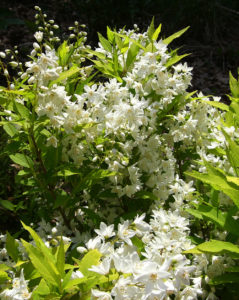
Deutzia ‘Chardonnay Pearls’
2. Exochorda ‘Snow Day Surprise’
This plant is a compact variety of pearl bush with a broadly upright habit. In full sun, its white blooms smoother this shrub in the spring. It’s a vigorous grower that will reach four feet tall quickly, but giving it a haircut right after it blooms will keep it compact. Flowers form on previous year’s growth, so it’s important to prune Exchorda immediately after flowering. Fertilize in early spring with a slow release fertilizer like Osmocote Plus. The “spring blizzard” is hardy to Zone 4 and prefers full sun.
3. Philadelphus ‘Snow Dwarf’
is a hybrid mock orange cultivar noted for its dwarf growing habit and abundant bloom of fragrant white double flowers in late spring. It’s arching habit gives it grace and makes it colorful from top to bottom on its two to three-foot frame. It’s called mock orange because its flowers resemble those of orange blossoms. This mock orange was developed in Canada and is hardy to Zone 4. Because it blooms on the previous season’s growth, if pruning is needed, it should be done right after flowering.
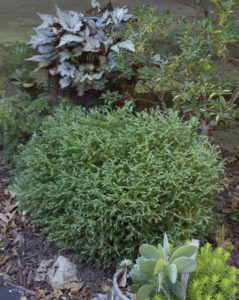
4. Thuja ‘Mr. Bowling Ball’
Maria Zampini of UpShoot LLC calls her company’s arborvitae introduction, ‘Mr. Bowling Ball a plant for gardening dummies. “It truly is a mantenance free plant – it grows into a perfect ball, needing no trimming to obtain or keep its shape.” Its ultimate height is less than three feet, and it is hardy to Zone 3. Although ‘Mr. Bowling Ball’ prefers full sun, I have it in a spot that receives just a few hours of direct sun in the morning. The spot contains a dwarf hemlock and an Enkianthus as well. What makes this space a challenge is that it is surrounded on one side by the blacktop driveway, and a brick patio and porch steps on the others. These surfaces heat up and retain the heat, which neither the Enkianthus or hemlock appreciate, event hough I provide supplemental water. ‘Mr. Bowling Ball’ saves the scenario with its carefree good looks and texture that makes it look more delicate than it really is. I’ll have to move the recalcitrant members of this trio to a more forgiving site and find something that can take the heat. But, for me, that’s the fun of gardening.
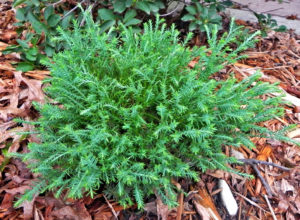
Top Left Photo: Thuja ‘Mr. Bowling Ball’ after one year. Photo Credit: Jean Starr Right Photo: Thuja ‘Mr. Bowling Ball’ after five years and no pruning. Photo Credit: Jean Starr |
 |
5. Cornus ‘Crème de Mint‘
This plant is smaller in stature compared to other yellow twig dogwoods, and is developed for disease resistance. Its variegated leaves offer summer-long interest, and its stems brighten up the winter landscape. According to Virginia Cooperative Extension, keeping the stems colorful is accomplished by 1) removing about one-third of the largest (oldest) stems in the early spring, or 2) cutting all stems down to 9 inches above ground level about every three years.
6. Itea ‘Merlot’
I plan to plant more of this native dwarf sweetspire, not only for its carefree disposition, but its beautiful spring flowers and fall color. Reaching just three feet, this naturally full shrub blooms profusely in mid to late-June. Its flowers look great in a vase, too. This is a shrub that forms flowers in the previous year, so it’s important not to prune the shrub in the spring, as you would be cutting off the flowers. If necessary, prune Itea right after blooming, and it will become a stalwart backdrop to other, more colorful plants. Until October. This plant has some of the best color in autumn’s arsenal. ‘Merlot’ turns a beautiful bright red, easily sending burning bush to the back of the shrubs standard list.
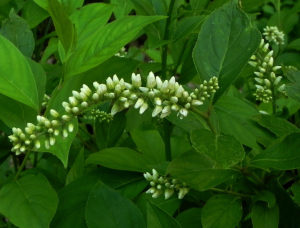
Itea ‘Merlot.’ Photo Credit: Jean Starr
Related Featured Articles
Related Videos
Related Blogs
Here’s more information about gardening that you’re going to want

Watch a Gardening Video

Learn About Osmocote Products

Read a Gardening Blog