
Mojo Berry Mulberry
Views: 8
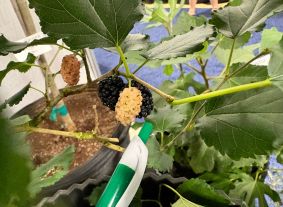
I interrupt this vegetable-focused blog to bring you a fruit—Mojo Berry—a mulberry worthy of your attention. To look at the fruits quickly you think, “Wait… is that a blackberry?” It’s not. Despite the name and the look of it, Mojo Berry is, in fact, a compact mulberry, botanically known as Morus rotundiloba ‘Mojo Berry’.
The confusion is completely understandable. The fruit looks strikingly similar to blackberries—elongated, clustered and ripening from red to a deep purple-black. To look at just the fruits, it’s easy to assume it belongs to the bramble family. But unlike blackberries, which grow on thorny canes in the genus Rubus, Mojo Berry is a mulberry in the genus Morus, growing on smooth, woody stems with no thorns in sight.
A Compact and Productive Mulberry
What makes Mojo Berry especially intriguing for home gardeners is its size and habit. Traditional mulberry trees can often grow up to 20–30 feet tall, making them impractical for smaller spaces. Mojo Berry, on the other hand, was bred to stay compact—typically topping out around 5–8 feet. What a world of difference! That makes it a natural fit for patios, small gardens and even containers.
It’s also impressively productive. Unlike many fruiting plants that take years to establish, Mojo Berry can produce fruit in its first season and continues to bear fruit over many months—from late spring into early fall. Even better, it fruits on both old and new wood, meaning you won’t need to concern yourself about pruning this variety the “right way.” No guesswork, just prune as you wish.
Growing Mojo Berry
Now that you are excited to grow Mojo Berry in your small back yard or even on your patio, here are some tips for success:
- Light: Full sun is best (6–8 hours) for strong growth and fruiting.
- Soil: Well-drained soil is key; it tolerates a range but doesn’t like to have its roots sit in wet soil.
- Water: Keep soil evenly moist, especially in containers, but avoid soggy conditions.
- Containers: Yes! It’s especially well-suited to pots; choose a container at least 18–24 inches wide with good drainage.
- Feeding: A balanced fertilizer in spring supports steady growth and fruiting.
Hardiness: Watch Your Zone
Mojo Berry is generally hardy in USDA Zones 7–10, which means it thrives in warmer regions with milder winters. In Zone 7, it can typically survive outdoors, though you may see some dieback after particularly cold winters. Zones 8–10 offer ideal conditions for consistent growth and fruiting.
For gardeners in cooler climates, such as Zones 6 and below, Mojo Berry is not reliably hardy in the ground. But that doesn’t put it out of reach. Instead, think of it as a flexible, container-friendly fruit plant. To be success with Mojo Berry in cooler Zones:
- Grow it in a pot so it can be moved.
- Overwinter it in a garage, shed or other protected space
- Or try a sheltered microclimate outdoors, understanding there may be winter dieback.
I realize I haven’t mentioned the flavor! It is a classic mulberry—sweet, mild and versatile. While it’s delicious fresh off the plant, it really shines in jams, baked goods and desserts.
Meet Ellen Wells

When you’re raised on a farm, you can’t help but know a thing or two about gardening. Ellen Wells is our expert on edible gardening.…
Membership Has Its Perks

- Ask The Expert Questions
- Newsletter Archive
- PlantersPlace Magazine
- Members Photo Gallery
- Product Ratings & Reviews
- Garden Club Samples
More information about edible gardening that you’re going to want

Edible Gardening Videos

Edible Gardening Podcasts

Got a Edible Gardening Question?