

This time of year I like to stroll the garden centers and peruse the online plant purveyors in search of spring-blooming bulbs on sale. I live in the Chicago area where you can place bulbs into the ground into late December before the soil freezes. But, there’s more enjoyment to growing bulbs than just popping them in your garden. I like to force spring bulbs to bloom indoors to create spectacular displays for the holidays (and for the dreary dark days that straddle the winter solstice).
My favorites are daffodils, hyacinths, muscari, scilla, tulips and snowdrops because they provide dazzling spring blooms although, truth be told, I love them all — from the tiniest Galanthus (snowdrops), which sometimes pop out of the snow-covered ground as early as January, to the big beefy King Alfred daffodils that appear three months later. In March and April, tulips with fringed and multi-colored petals mingle with grape hyacinths. Planted in groups of 5, 7 or 9 bulbs, daffodils in brilliant golds, orange and yellow — Jet Fire, Tete-a-Tete and February Gold — provide a punch of color to my flower beds. They fill the late winter and early spring months with plenty of eye candy before spring perennials and pansies start to bloom.
Stock up when bulbs are on sale
By early November the local garden centers are starting to place their bulbs on sale. It’s a temptation that I just can’t resist. To get the effect I want, it takes bags and bags of bulbs because you can’t plant too many.When considering bulbs that are on sale, give them a little squeeze to make sure they are firm and not squishy or rotting. They should be free from mold spots, too.
I always manage to have several leftover bulbs that don’t make it into my garden, and, that’s okay. I store them in our attached garage where it is cold, but not freezing. There, they have a few weeks of needed cold exposure before I plant them indoors. A period of cold storage is how to force spring bulbs to bloom indoors. It’s a real treat because having daffodils and tulips bloom on a windowsill brightens our home at a time when it’s often snowing.
Spring-flowering bulbs need a spell of cold weather especially if you want to force spring bulbs to bloom indoors. Don’t have a cold spot yet? Place the bulbs in paper bags in the refrigerator for a few weeks (but not the freezer).
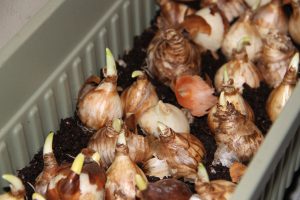
Photo by Nina Koziol
Planting bulbs in containers
Starting in November, I put soil-less potting mix in several plant pots and small plastic window boxes. Then the fun begins. I plant mixtures of bulbs in the containers. They’re watered and set in a bright, cool window. If the bulbs have not had a few weeks of cold treatment, after planting I place the pots back in the garage. Once the leaves appear, I bring them indoors. Within weeks, the leaves and buds appear. By the holidays and well into January, our house is filled with an abundance of blooms. To keep the display going, I’ll stagger the planting every week or so from November through December.
Every container I use has drainage holes—a necessity—otherwise the roots can easily rot if you overwater. Because the pots are indoors, I always place saucers and trays below them to catch excess water so it won’t damage furniture.
You’ll need a small bag of soil-less potting mix that contains granular fertilizer. I fill the pots with moistened mix to within about 4 inches of the rim. Then, I set the bulbs close together because I want an over-the-top display. The pointy end of daffodils and tulips is called the nose. They may not have visible roots, but you should see some fibers on the base of the bulb. Larger bulbs go in first, nose up, and then I sprinkle a light layer of soil mix so that it barely covers them. Next, I pop in smaller bulbs (grape hyacinths or shorter tulips) and continue adding soil mix until it reaches about an inch below the pot’s rim.
If the soil is too close to the top of the pot, the soil will overflow when you water. Place the container where it will get low-to-bright light, but not direct sunlight. Keep the soil moist but not soggy. Empty any standing water from the tray or saucer after an hour or so.
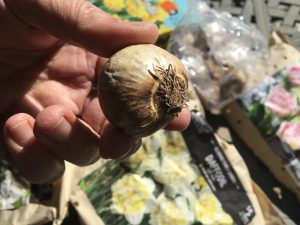
Photo by Nina Koziol
Getting the bulb combinations right
Some of my favorite combinations are a mixture of very tall daffodils together with short daffodils and grape hyacinths. Tall, white-flowered ‘Maureen’ tulips can be planted with ‘Baby Moon’ daffodils, which will produce three to five sweet-scented, canary-yellow flowers on each stem. Muscari (grape hyacinths) are wonderful as a carpet below yellow-flowered daffodils or pink tulips. Grape hyacinths grow to about five inches tall, they are not all grape-colored. Some varieties are white, purple, pink, purple and white, pink and white, or solid yellow, so there is plenty of room for artistic pairings.
Create tabletop bulb displays
Placed on a kitchen or dining room table, a coffee table, mantlepiece or a countertop, spring-blooming flowers make a room festive and inviting. For a fun centerpiece, I place pots of blooming daffodils and tulips on top of small glass cake pedestals. I scour resale shops for pedestals in different sizes. They’re inexpensive and add to the display.
Stage the pots in the middle of the table and surround them with small candles. If I’m using one large pot or a long window box, I’ll cut some small curly twigs from the garden and pop them into the center of the display. To cover the soil surface, I sometimes tuck sheet moss (sold in craft stores) around the base of the leaves. The flowering tabletop displays make for great conversation pieces.
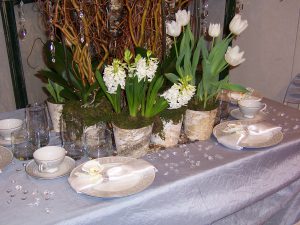
Photo by Nina Koziol
Move the bulbs outdoors after they’ve bloomed
The best thing about growing hardy spring bulbs indoors for a cheerful winter display is that the bulbs can be planted outdoors in the spring. Once they’ve finished blooming indoors, I continue watering until the leaves become dry. When the leaves are totally dry, I plant the bulbs outdoors. An exception is paperwhite narcissus—a tender daffodil that is not hardy in our Zone 5 garden. Once they finish blooming indoors, they go into the compost pile.
Tulip bulbs do not like to be in wet soil in the summer, so I pop them into a shade garden where drought-tolerant perennials, such as hellebores, epimedium and hostas grow. By the time the bulbs finish blooming the following spring, the perennials cover up the dying leaves.
Time to start the bulb forcing process
There’s plenty of time left to purchase bulbs on sale and to prepare to force spring bulbs to bloom indoors. Check out the local garden centers, big-box stores, and the online resources below. As long as the soil has not frozen, you can go ahead and plant outdoors. And, once your extra fall bulbs get a cooling period in a garage or in the refrigerator, they’ll be ready for planting indoors. Get those bulbs now, so you can brighten the dark, cold winter months ahead with a little hint of spring. Happy Growing.
Online bulb sources
John Scheepers
Old House Gardens Heirloom Bulbs
https://oldhousegardens.com
Netherland Bulb Co.
https://www.netherlandbulb.com
K. van Bourgondien
Good ‘reads’ (about bulbs):
“Tabletop Gardens: 40 Stylish Plantscapes for Counters and Shelves, Desktops and Windowsills,” (Storey Publishing, 168 pages).
“Timber Press Pocket Guide to Bulbs,” (Timber Press, 228 pages)
“Daffodil: The Remarkable Story of the World’s Most Popular Spring Flower” (Timber Press, 220 pages)
More bulb information:
American Daffodil Society
Brent and Becky’s
Related Featured Articles
Related Videos
Related Blogs
Here’s more information about gardening that you’re going to want

Watch a Gardening Video

Learn About Osmocote Products
Read a Gardening Blog

Find a Gardening Podcast
Membership has its perks!
Become a PlantersPlace member! Registered users can ask Marianne Binetti questions, create personal photo gallery and post product reviews.