

Know Your Zone: Understanding Your Local Weather
The United States land mass covers nearly 3.8 million miles. Within the country there are weather extremes that have ranged from -80°F in Alaska (1971) to 128 °F in Arizona (1994). To help gardeners and growers select plants that will survive and thrive in their part of the country, the United States Department of Agriculture (USDA) compiles a Plant Hardiness Zone Map, an excellent tool for any gardener.
The most recent map, published in 2012, is based on the average annual extreme minimum winter temperatures at a given location. Scientists compiled the map based on data collected over a 30-year span.
Hardiness zones do not reflect the coldest it has ever been or ever will be where you garden. Instead, the zones tell the average lowest winter temperature for a given location.
Low temperatures during the winter play a key role in the survival of plants at specific locations. Knowing your hardiness zone can guide you in the selection of winter-hardy plants. You can find the hardiness zone for your state and the average annual extreme minimum temperatures at the USDA’s web site: http://planthardiness.ars.usda.gov/PHZMWeb/
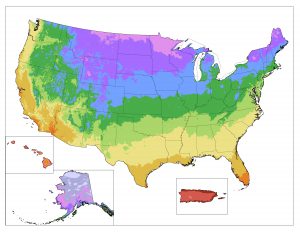
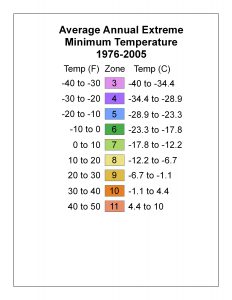

Microclimates: Gardening at the Edges of the Hardiness Zone
Weather patterns are constantly changing. Some gardeners opt to try their luck at growing plants that may not survive winter cold in their area. For me, that’s been one of the enjoyable challenges of gardening in the Chicago area, where some winters have produced -80°F wind chills, while other years, we’ve had 50°F days in January.
I garden in Zone 5b. When buying perennials or shrubs that may not be hardy in our area, I look at microclimates in our garden. A microclimate can be a spot in the garden protected by a hedge, a fence, a garage or a house. If the plant I’m buying is rated Zone 6 (which is typically warmer than Zone 5 in winter), I look for a protected spot away from winter winds to plant it.
Microclimates can be warmer or cooler than other spots in your garden. For example, my vegetable garden sits seven feet lower than the front borders. Because it is low, the cold air settles there first. In spring and in fall, I must provide additional protection for vegetables (covering them with pots, row covers or cardboard boxes at night, so they don’t become frost damaged).
Varieties to Consider
One of my favorite smaller trees is the Japanese maple (Acer palmatum). I’ve learned that this plant prefers Zone 6 even though it is sometimes listed as hardy to Zone 5. It has been notoriously fussy in our garden because I’ve planted some of the trees on the west side of our house where they were blasted by cold winter winds. After losing a few small trees, I planted some on the north side of the house, where they receive part shade and they’re protected in winter. There, they’ve survived and thrived over the past five years.
Panicle hydrangeas, on the other hand, are hardy to Zone 4, which can dip down to -30°F to -40°F during winter. I grow several of these beautiful shrubs out in the open and they are well adapted to our Zone 5 winter weather.
When considering a tree, I look at the tag to see if the grower has listed a hardiness zone. For example, if the tag (or grower’s web site) lists the plant as hardy in zones 4 – 9, I know it will likely survive in our zone’s extreme winter temperatures. You can find a list of cold-hardiness ratings for many woody plants at the U.S. National Arboretum’s web site: http://www.usna.usda.gov/Hardzone/hrdzon4.html#5
Other Factors
The hardiness zone map is a great tool for gardeners, but it’s just a guide. In time, you will have hands-on experience and knowledge about the spots in your garden that warm up first in spring or cool down quickly in fall. Think about those places when you’re buying plants.
Consider that in early autumn, a zone may experience extremely cold weather. This can injure plants even if the temperatures don’t reach the average lowest temperature for your zone. Very warm weather in midwinter followed by a sharp change to more seasonably cold weather can also injure plants.
An 18-foot tall Dawn Redwood tree placed on the west side of our house, quickly leafed out one March when the weather hit 80 degrees and then dropped to freezing the next day. It was not prepared for those conditions and it died. Perhaps if it was planted elsewhere in a protected spot in the garden, it would have survived.
Wrapping the trunks of young trees in fall can help prevent them from cracking during the winter. When in doubt, I’ll wrap smaller shrubs in burlap to protect them from drying winter winds.
Besides hardiness zones, other factors contribute to the success or failure of plants. Wind, soil type, soil moisture, humidity, pollution, snow, and winter sunshine can greatly affect their survival. Where you place a tree or shrub, how you plant it and care for it also influences its survival. Some plants can survive a short period of exposure to cold but longer periods of cold weather may injure or kill them.
Additional Online Plant Hardiness Zone Resources
Definition. https://en.wikipedia.org/wiki/Hardiness_zone
What’s New? http://planthardiness.ars.usda.gov/phzmweb/AboutWhatsNew.aspx
Interactive Zone Map. http://planthardiness.ars.usda.gov/phzmweb/interactivemap.aspx
User’s Guide. http://planthardiness.ars.usda.gov/PHZMWeb/Help.aspx
Perennials by Zone. https://www.plantdelights.com/pages/plant-hardiness-zones
History of Zone Maps. https://www.plantdelights.com/blogs/articles/plant-hardiness-zone-maps
Related Featured Articles
Related Videos
Related Blogs
Here’s more information about gardening that you’re going to want

Watch a Gardening Video
Learn About Osmocote Products
Read a Gardening Blog

Find a Gardening Podcast
Membership has its perks!
Become a PlantersPlace member! Registered users can ask Marianne Binetti questions, create personal photo gallery and post product reviews.