

Growing succulents is a great option for those who want to have living plants in the home, but who also feel like they possess a brown thumb. That’s because succulents are easy to care for and will thrive even with neglect. This article, a kind of succulent basics 101, explains what you need to know. Succulents come in dozens of different sizes, shapes, colors, all with unique care needs, so no matter your gardening experience and knowledge there is a succulent just right for you.
Succulent Basics 101
Succulents need light. Imitating the light needed is usually the hardest part. Most succulents crave the brightest light possible. Indoors, a south facing window is optimal. Then the west and/or east sides of your home. If you can, place succulents outside during the spring and summer, just remember to acclimate them slowly or they will get a sunburn. Seriously! If your windows just don’t get enough sunlight, or you see your plants starting to stretch, consider adding grow lights.
Even though succulents are drought tolerant, they do need some water to survive. This is where neglect can help. If you tend to forget to water your plants, succulents can go a long time between drinks. In fac, too much water is the number one way to kill them. A good rule of thumb, if your soil feels dry, then wait a few more days and hen water it, thoroughly.
If there are children in the house, here is a fun idea. Find out where your succulent originated from, country, state, or continent, then follow the weather for that particular area. If it forecasted to rain, water your plant. Try to mimic the weather as much as possible. If it is going to be very hot for a few days, maybe put a small space heater near the plant. This will teach the child about caring for a living thing and about different parts of the world.
if you decide to amend the soil, use a high quality potting soil. It will cost a bit more, but not much is required so a little goes a long way. The average bagged potting soil will tend to stay too wet for most succulents. However, there are cactus soils available. If you use something else, be sure to add generous amounts of sand, gravel, perlite or volcanic rock to increase the drainage.
Succulents are slow growers hence do not need much in the way of fertilizer. I recommend feeding succulents once in the spring and once again in late summer. Use a balanced, slow-release fertilizer, with NPK ratios of 8-8-8, 10-10-10 or 14-14-14.
The container to selected for growing succulents is really a personal choice. Make sure there is ample room for the plant. Succulents dislike being crowded together – even though they are sold that way. There should be lots of drainage because too much water is the number one enemy. The container is sturdy enough to support the plant and not disintegrate in a short period of time. Some thoughts on some of the types of pots available: terra cotta (although they the soil tends to dry out faster), glazed pots (but they tend to retain more moisture), and plastic (but such pots eventually cause dry rot and are subject to cracking). Containers with no holes are a no-no.
Best Succulents Basics for Beginners
Like all plants there are some that are much easier to grow than others. For those new to the plant, I recommend the following —
Aloe species. People use Aloe Vera for medicinal purposes (burns) as well as for decoration. Aloe Vera is the most common type of aloe, it is native to the tropical region of North Africa. Other types of Aloe have variegated foliage, they can be green or grayish-green, smooth edged or have teeth, and some have little white specks which adds to their visual appeal.
Crassula species. Also known as Jade plants, these succulents are tough cookies. They are easily identified by their fleshy, bright green leaves. The leaves may be stacked upon each other, be oval in shap and growing up a stem. Some are fuzzy, and some have red edges. There are tubular shaped leaves and leaves that have no discernable shape. The Crassula ovata or common Jade plant is also considered a lucky symbol for money. It has names such as Friendship Plant”, “Money Plant,” and ” Dollar Plant”.
Sanseveria species. This plant can go by different common names, such as “Snake Plant” and “Mother-in-Law Tongue”. Sanseveria varieties have stiff, upright, sword-like leaves that may be solid green, banded, spotted or edged in gray, silver, or gold. These plants are very tolerant of low light and drought. They also are effective at cleaning the air, removing toxins such as formaldehyde and benzene from indoor environments, making them the perfect house plant.
Haworthia species. Very often confused with Aloe plants, these spikey plants are even easier than their mis-identified, though related, brethren. All species of Haworthia originated in South Africa. If you want diversity, these plants will not let you down. The leaves can be hard, soft, long, short, or grass-like. They have a wide range of colors, some with lines, hairs, and spines. Depending on species, they only average three to six inches, and prefer bright, indirect light. Direct sun can make the leaves shrivel up or cause brown scorch marks.
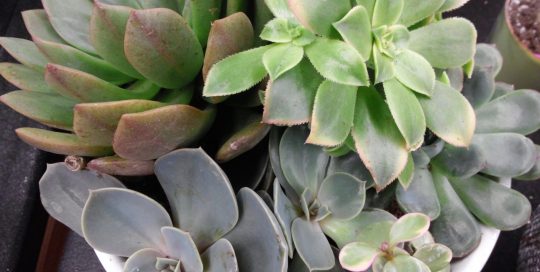
Echeveria species. If there are any succulents that should be handled with extreme care, this would be it. The leaves break off easily. Echeverias grow as rosettes, usually only 2 – 6 inches across on very short stems. The rosette has fleshy, blue-green leaves that become tinged with red when exposed to sun. You should handle it with care because you can easily damage the leaves.
Sedum morganianum. Burro’s Tail, or Donkey’s Tail, is especially good for a hanging basket or if you want the plant to trail down a tall flower pot. It has gray-green or gray-blue tiny “pea shaped” leaves on a stem that grows up to 3 feet long. Hang them in the corner of a room where it can get as much light as possible. Try to keep the “tails” from getting too long. If you have pets or children, the little, tear-drop leaves can break off very easily.
Lithops species. These ‘living stones’, as they are often called, are one of the slowest growing, unusual succulents. They are called living stones for a very good reason. The camouflage prevents thirsty animals from eating them during a drought. They look like two brightly colored pebbles sitting next to each other and don’t get much taller than one inch in height. To grow, they will need very bright light and an extremely light hand with water. The ‘stones’ can burst if they receive too much. There is a vast amount of color variations in this species and it is highly unlikely that you would ever be able to collect them all.
Pests That Prey on Succulents
Most indoor succulents have very few pests. Aphids, Mealy Bugs, and Spider Mites, being the three main culprits. Aphids are the most common. To remove any of these pests, you can hose your plants off with a good stream of water in the sink. You can use insecticidal soap if they start to get out of control. Use a cotton swab dipped in alcohol to wipe away the larger insects, such as mealy bugs.
Succulent Basics 101 Summary
Succulents are very forgiving. They thrive on some neglect, can help keep the indoor air clean, and will bring a little bit of nature into your home. There are many different styles, varieties, and growth patterns to choose from. With a bit of research you will find something that would fit your desires and needs.
Related Featured Articles
Related Videos


Related Blogs
Here’s more information about gardening that you’re going to want

Watch a Gardening Video

Learn About Osmocote Products
Read a Gardening Blog

Find a Gardening Podcast
Membership has its perks!
Become a PlantersPlace member! Registered users can ask Marianne Binetti questions, create personal photo gallery and post product reviews.