

Take a Trip Down Salvia Lane
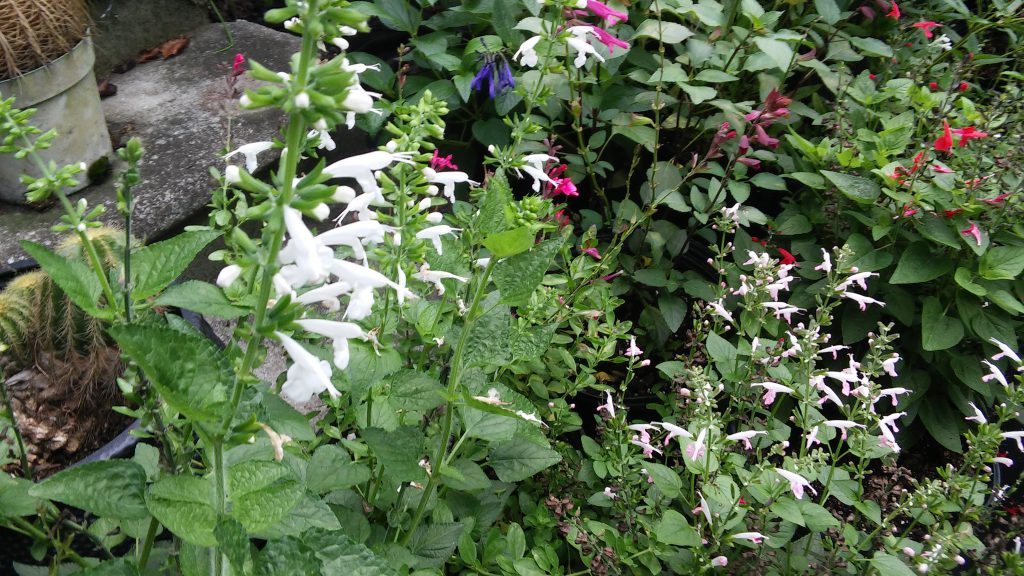
Salvias are one of the largest groups of flowering plants. The number of salvia species is estimated to range anywhere from 700 to nearly 1,000. In this group there are shrubs, perennials and annuals. Blossoms have varying colors from white, reds, pinks, purples, blues and bi-color. No matter which color you prefer, or which type of growing conditions you have, there is more than likely some kind salvia for you.
These workhorse plants are used for mass plantings, borders, containers, accents, cut flowers and enhancing certain foods. In addition to its colorful flowers and interesting foliage – which is sometimes scented – one of the main benefits of growing salvias is for the hummingbirds, bees, and butterflies that they attract. As an added bonus, for those that have this issue, they tend to be deer resistant.
Five Common Species of Salvias
While there are many types of salvia, the remainder of this article covers five of the most common species. The list was selected for those species that are easiest to find. Advice on planting zones and which type of salvia is best for the conditions in each zone, is also provided. With that being said, what may be an annual in one situatiuon may be a perennial in another.
“Hot Lips”
Salvia microphylla
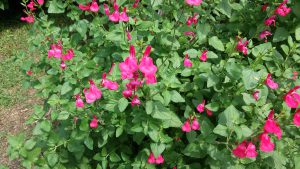
This plant grows on average 3.5 to 4.5 feet tall and wide. It blooms in its first year, and then grows to its full size in the second year. The leaves are basically egg shaped, with varying sizes, and can be smooth or lightly covered with hairs. When you crush the leaves, they have a strong fragrance, which has been described as mint-like.
Salvia microphylla
This Saliva is a complex species which can be easily hybridized, resulting in numerous hybrids and cultivars that bloom heavily in late spring and again in fall, with sporadic flowering year-round in milder conditions. They are hardy to 10 degrees F or less. In cold-winter areas, dieback to the ground may occur, but they usually burst back with new, vigorous growth in spring. Even though they are ideal for sunny borders in hot climates, it would prefer some afternoon shade. Because of it being a little less comfortable with late afternoon sun, this is why this species mostly flowers in spring and autumn. A good cultivar to look for would be ‘Hot Lips’; the flowers are white with a bright red top resembling lipstick.
“Black and Blue”
Salvia guaranitica
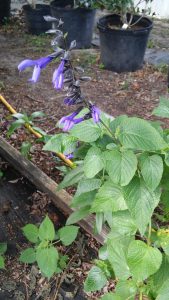
This perennial will grow 5 to 6 feet tall, spreading into a large patch through its adventurous roots. Works well as a backdrop for your flowerbed. The flowers can be up to 9 inches long in various shades of blue. This includes a true blue, which is fairly rare in the flower world. Zoned 7-10, flowering begins in mid summer and continues until frost. Growing best in moist, well-drained soil, it is drought tolerant and will benefit from a little afternoon shade. The absolute best cultivar of this species would have to be Salvia guaranitica ‘Black and Blue’.
Salvia splendens
This plant is a native of Brazil that is typically grown as a warm weather annual bedding plant here in the U.S. This particular species has been a garden standard, reliably blooming over a long period of time. As time goes on, more and more varieties are being developed, giving us a wider range of colors, including white, salmon and purple, as well as the traditional flaming red. With varying heights from about 8 inches to nearly 3 ft, there is something in this species to fit every application. Some of the outstanding characteristics of Salvia splendens, like many of the others, it is deer and rabbit resistant and it is considered non-invasive, but will self-seed some, usually not becoming a problem. Seeds are the easiest form of propagation.
Salvia leucantha
Salvia leucantha
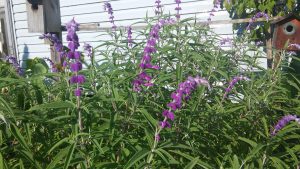
Commonly called Mexican bush sage, this is an evergreen shrubby perennial (Zones 8-10) that is native to Central America and Mexico. Average heights of 4-6 feet make this one of the larger species of Salvia. Typically, you will find the cultivar ‘Santa Barbara’ that has white flowers protruding from a purple sepal, the part that protects the flower before it opens, which makes a magnificent contrast of colors.
There are some newer ones out that are purple on purple, such as ‘Midnight’ and ‘Purple Velvet’ which has a more pinkish purple flower coming from the purple sepal. Salvia leucantha can be grown in full sun to light shade and is somewhat drought tolerant, but does better with regular irrigation. The somewhat rampant growth rate can be controlled by judicious watering practices, but could impede the flowers. It will remain evergreen to 25 degrees and root hardy to 18 degrees, possibly even lower with a good mulching.
Salvia officinalis
This is the most common of all salvias, especially if you do a lot of cooking. Also known as the culinary sage, it is a perennial (Zone 4-11), evergreen shrub with woody stems, grayish leaves, and blue flowers with a purplish sepal. This sage has been revered for centuries for its medicinal as well as culinary uses. The Ancient Egyptians used it as a fertility drug, in Germany; sage tea is used as a gargle for inflammations of the mouth and throat. Some studies have even shown that sage can help boost memory in young and healthy adults. Salvia officinalis can be grown from seeds, but the best way to grow a high-quality plant is with cuttings from an established plant.
There are many interesting cultivars of this species, some of which are as follows:
- ‘Alba’, a white flowering cultivar
- ‘Berggarten’, a cultivar with large leaves, which sadly, rarely blooms, but this does extend the usefulness of the leaves
- ‘Extrakta’, has leaves with higher oil concentrations
- ‘Purpurascens’ (‘Purpurea’), a purple-leafed cultivar
- ‘Tricolor’, a cultivar with white, purple and green variegated leaves
Bonus Species
As a whole, salvias are carefree and easy to grow. In the landscape, they are tolerant of a lot of different conditions, but wet, poorly aerated soils can cause root rot. Heavy clay soils will retard root growth and starve the plant of oxygen, which can lead to other root diseases. However, as a bonus Salvia species, you may wish to consider Salvia uliginosa or Bog Sage. It is an open, upright plant with clear sky blue flowers and unlike most salvias, it thrives in damp, boggy soil, though it will grow well in other areas of the garden as well. Just make sure you amend your soil with lots of compost or grow them in containers, even if you are attempting the Salvia uliginosa.
Other Considerations in Planting Salvias
In areas of high rainfall or a heavy hand with irrigation and high temperatures it may be better to use a fertilizer. Osmocote has a slower release rate,which is good for higher temperatures. Otherwise, regular fertilizers will release too quickly. You really do not want to over fertilize. Too much nitrogen will promote excessive foliage growth and lessen flower production. Too high of nitrogen levels can also cause soft and weakened stems.
When it comes to the multi-legged pests, there are a few that may come visit, such as aphids, thrips, whiteflies and spider mites. The first three are a breeze to control with insecticidal soap as they are soft-bodied insects. The spider mites will need something a tad stronger such as a miticide or neem oil.
Finally, remember to pinch off spent flowers (also known as dead heading) to encourage continuous blooming. This will keep a nice, neat appearance. No matter if you grow your salvias in the ground or a container, remove weeds from the plantings because they will compete with your prized plants for moisture, nutrients and light.
I hope this little trip down Salvia Lane has given you some enlightenment and motivation to try one or two or maybe ten different species of salvia. I encourage you to seek out and try some of the other many species of Salvia that are out there, this is truly a very small sampling.
Related Featured Articles
Related Videos
Related Blogs
Here’s more information about gardening that you’re going to want

Watch a Gardening Video
Learn About Osmocote Products
Read a Gardening Blog

Find a Gardening Podcast
Membership has its perks!
Become a PlantersPlace member! Registered users can ask Marianne Binetti questions, create personal photo gallery and post product reviews.