

As an avid gardener, this is what to know about ticks and Lyme disease. Living in the Chicago suburbs, I encounter many insects, both beneficial and harmful. Ticks fall into the harmful, bad bugs category. Unlike shiny Japanese beetles that chew my hibiscus flowers until they look like lace doilies, ticks are much smaller, but they are capable of harming pets and humans. I discovered that the hard way last summer when I contracted Lyme disease after a tick—the size of a poppy seed—bit me in our garden! Header photo (c) stock.adobe.com
What to Know About Ticks and Lyme Disease: So, What Is Lyme Disease?
Lyme disease is one of several serious illnesses spread by ticks—small, blood-sucking parasites. The Lyme disease bacterium, Borrelia burgdorferi, is transmitted through the bite of infected blacklegged ticks, also called deer ticks. (These ticks spread the disease in the northeast, mid-Atlantic, and north-central United States. The western blacklegged tick spreads the disease on the Pacific Coast.)
It’s mind-boggling that something so tiny can cause so much distress. Symptoms can include fever, rash, headache, muscle and joint pain, facial palsy (where one or both sides of the face droop), arthritis, heart problems and worse. A rash occurs in about 70 to 80 percent of people who are bit. The rash often looks like a bull’s-eye inside a large red area. But, not everyone who is bit develops a rash.
Lyme disease was first recognized about 1975 near Lyme, Connecticut, and spread across New England and the upper Midwest. It is now making its way big time across northeastern Illinois. Despite that, local health-care providers are still not showing alarm. That’s partly because Lyme disease symptoms are similar to other illnesses.
Reported cases of Lyme disease have more than tripled since 1995 and the Centers for Disease Control and Prevention (CDC) now estimate that more than 300,000 Americans become ill each year. Anyone who spends time outdoors in tick-infested areas—gardeners, hikers, campers, landscapers, utility workers—is at risk.
Lyme Disease Treatment
When a person contracts Lyme disease, the body produces antibodies in response to the infection. To diagnose the disease, a blood test is used to detect theantibodies. People treated with appropriate antibiotics in the early stages of the disease typically recover completely, but it can take six months or more to feel good again. If you suspect you have Lyme disease, see your doctor.
If left untreated, the infection can spread to joints, the heart and the nervous system. This can result in heart palpitations or an irregular heart beat (Lyme carditis). Lyme disease may also cause dizziness or shortness of breath. Other symptoms include shooting pains, numbness, or tingling in the hands or feet.
Is It a Tick?
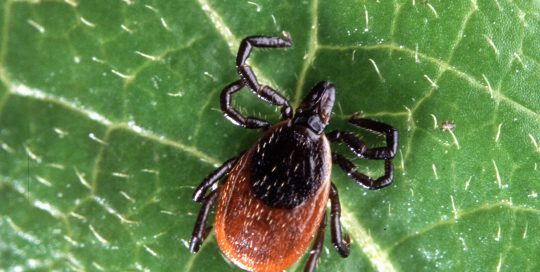
Ticks are arthropods (invertebrates with external skeletons and jointed legs) found throughout the United States. Deer ticks feed on white-footed mice, white-tailed deer, as well as other mammals and birds. While they’re waiting for their next meal to walk by, ticks may sit on grasses, perennials, annuals and shrubs (typically not on trees). From there, they crawl (they don’t jump or fly) onto an animal or a person who brushes against the vegetation.
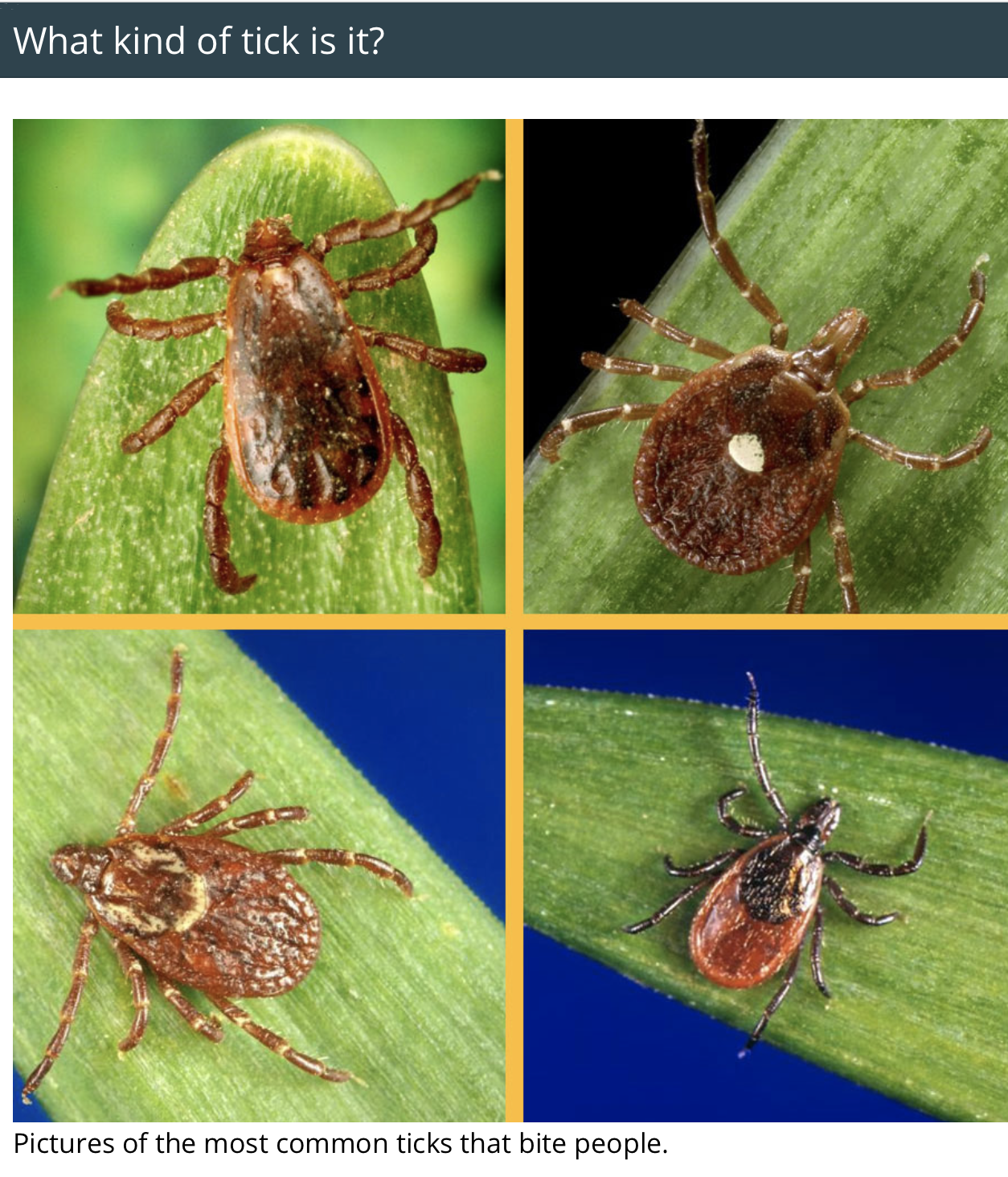
Photo courtesy of CDC
Ticks are found mainly in areas with woods, prairies, shrubs, weeds and tall brush orgrasses—so of course it makes sense that they could easily hang out in a garden. They can reside under fallen leaves, ground covers and sometimes on lawns as well as around stone walls and woodpiles where mice and other small mammals live.
They range in size from as tiny as a poppy seed to as large as a pencil eraser. Most ticks go through four life stages: egg, six-legged larva, eight-legged nymph, and adult. After the eggs hatch, ticks must eat blood at every stage to survive, but it is the extremely small nymphs that are worrisome because they are difficult to spot. Adult ticks can transmit the disease, but because they are larger and more likely to be removed from a person’s skin within a few hours, they are less likely than nymphs to have sufficient time to transmit the bacteria.
Pain, Pain Go Away
I almost always wore gardening boots, long pants, long-sleeve tops, sun screen, a hat and gloves when working outdoors last spring. But when the weather suddenly warmed up in June, I was gardening in sandals. I spent a lot of time weeding, planting and watering because we were expecting about 300 people for a garden walk.
The walk was June 29, but I couldn’t spend much time with visitors. I was inside with a 102-degree fever, a bad headache and felt exhausted.
It took three visits to the emergency room, several tests and more trips to the doctor before I was diagnosed with Lyme disease. By then it was September. The ER doctors could not determine the cause of the fever or the pain that radiated across my back and ribcage. It wasn’t until I developed facial palsy on the right side of my face, and terrible stomach pain that I went back to the doctor’s office.
This time it was a different doctor. She asked me if I’d been camping (I had not). And, then it struck me when she mentioned spending time outdoors—ticks! A blood test confirmed the disease. The therapy was three weeks of antibiotics.
I thought more about how this happened. I vaguely recalled that in June I felt something very tiny crawling on top of my foot. After I brushed off what I thought was an itsy, bitsy spider, I wondered why its legs curved forward. But I didn’t think any more about it. A week or so later, I had a very small rash by my ankle and thought it was a spider bite. Looking back, it was a tick, not a spider and it had infected me! The antibiotics took care of the infection, but it was six months before all of the symptoms finally disappeared.
How to Use What to Know About Ticks and Lyme Disease to Protect Yourself
In the Chicago area, tick exposure can occur throughout the year but ticks are most active during the warmer months (April-September). Ticks survive our cold winters and become active when the weather is above freezing. Anytime I’m in the garden now (or hiking), I wear boots, long, light-colored pants tucked into my socks, a long-sleeved top and a hat.
And, we spray ourselves with tick-repellant. We treat our clothing and hiking gear with products containing 0.5% permethrin. Permethrin can be used to treat boots, clothes and camping gear and it remains protective on clothing through several washings. You can also buy permethrin-treated clothing and gear.
We’ve also purchased tick tubes, but you can make your own as well. (Google DIY tick tubes.) The tubes are filled with cotton that contains permethrin. Mice and other small rodents like chipmunks enter the tubes and take bits of the cotton back to their nests. The permethrin sticks to their fur and kills the ticks. While this can help tamp down the tick population, ticks can also come into a garden on birds, deer, raccoons, possum and squirrels so I’m always on the lookout.
Ticks enter into the house on your clothing or on a pet. Check yourself, your children and your pets when you come indoors. After spending time in your garden, woods or prairie, remove your clothes and wash and dry them.
Removing a Tick
If you do find a tick stuck to your skin, the Centers for Disease Control offers these recommendations for removing it:
- Use fine-tipped tweezers to grasp the tick as close to the skin’s surface as possible. The key is to remove the tick as soon as possible. Avoid folklore remedies such as using nail polish, petroleum jelly, or heat to make the tick detach from the skin.
- Pull upward with steady, even pressure. Don’t twist or jerk the tick; this can cause the mouth-parts to break off and remain in the skin. If this happens, remove the mouth-parts with clean tweezers. If you are unable to remove the mouth parts easily, leave them alone and let the skin heal.
- After removing the tick, thoroughly clean the bite area and your hands with rubbing alcohol, an iodine scrub, or soap and water.
Resources for What to Know About Ticks and Lyme Disease
The Centers for Disease Control and Prevention https://www.cdc.gov/lyme/index.html
Illinois Department of Public Health: http://www.idph.state.il.us/envhealth/pccommonticks.htm
Related Featured Articles
Related Videos

Related Blogs
Here’s more information about gardening that you’re going to want

Watch a Gardening Video

Learn About Osmocote Products

Read a Gardening Blog