

Arbor Day is a time set-aside to be sure we appreciate our trees and forests. It is a holiday that celebrates the planting, upkeep and preservation of trees. The term, arbor, literally translates from Latin and simply means, ‘tree’. Trees are all around us, too. Just look out the window. The chances of seeing one is almost 100%. Trees are a foundation in any landscape, they line roads in the country, make statements in city parks, and what would a childhood be like without a tire swing in a grand oak?
How Arbor Day Started
The idea of Arbor Day originated in 1854. It was the brainchild of a Julius Sterling Morton who was from Detroit. He and his wife, Caroline, were lovers of nature. They quickly planted trees, shrubs, and flowers. The first Arbor Day was first observed in 1872, in Nebraska City, Nebraska. On January 4 of that year, Mr. Morton proposed a tree-planting holiday. He suggested calling it “Arbor Day”. He presented it at a meeting of the State Board of Agriculture. They set the date for April 10, 1872. They offered prizes to counties and individuals for planting “properly” the largest number of trees that day. It was estimated that more than one million trees were planted in Nebraska on that first Arbor Day.
In 1885, Arbor Day was named a legal holiday in Nebraska and April 22, Morton’s birthday, was selected as the date for its permanent observance. Today the most common date for other state’s observance is the last Friday in April. Subsequently, several U.S. presidents proclaimed a National Arbor Day on that date. There are a number of other state Arbor Days held at other times to coincide with the best tree planting weather for their particular area. Dates range from December through March in the south to May in the far north.
Why is Arbor Day important?
Arbor Day has been celebrated for over 100 years. One only needs to look at the destruction and damage that deforestation has had on the environment to see why is as important today as it was when it was first celebrated. When trees are removed, animals lose their homes. All mammals, including humans, lose an important supply of oxygen.
Trees can no longer be taken for granted! It is vital that we learn more about trees and about the role they play in our landscape and environment. Trees reduce the erosion of topsoil by wind and water, they cut the heating and cooling costs of your home, they moderate the temperature of the environment around us, and they clean the air. They are a renewable resource that gives us paper to write on, wood for our fireplaces, fuel for our camp fires as well as countless other products. Additionally, trees in a city increase property values, as well as enhance and beautify the community.
Organize an Arbor Day Event
Arbor Day is a fantastic way to unify your neighborhood! If you educate the good folks in your area, and tell them how important trees are, I wager some will agree to come together and plant a few trees in a local park or playground. Find some land where the addition of a tree will be welcomed, and then organize the event. Don’t be put-off if you have never planted a tree yourself – it is not as hard as you think.
Find the Right Tree for Your Area
To start, research the types of trees native to your area. Just because something is growing down the street from you does not mean it is a good idea to plant more. One of the most common reason for tree planting failures is to try to force a species into a region that can’t accommodate it. The climate is changing. Trees that were once native to a particular area are migrating into adjacent areas. Some non-native trees are undesirable because they are invasive. Bradford Pear trees come to mind. Ask your local extension agent for advice as to which trees are appropriate for your area.
Locating a Source for the Trees
The next step is to source the trees from a reputable nursery. You will need to have funds available for purchasing the trees because they will not ‘free’. Prices vary depending upon species, size and market conditions in your area. Your neighbors may be willing to provide funds for the tree purchases, or you may be able to locate a local corporate sponsor. One way to stretch the donations for trees the farthest is to go ‘small’. One of the nice thing about trees: they will grow! Not only are smaller trees cheaper, they will be easier to handle.
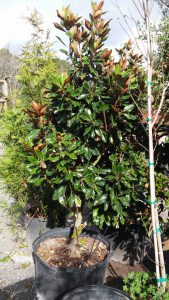
This Little Gem Magnolia is a smaller version of the mighty Magnolias. Photo by Darren Sherriff
How to Plant a Bare Root Tree
Okay, so you have the place to put it, know what kind of tree you want to plant, and you may have already acquired the tree, now what? It’s time to get dirty.
How to plant the tree depends on whether you get a bare root tree (no soil or pot and usually dormant) or a containerized tree. Let’s start with a bare root tree. It is normally cheaper, by the way. It may also be the only tree available at the time you wish to plant. Allow the tree’s roots to soak in water an hour or two before planting. However, this is not a case where more is better. Do not to allow the tree to soak for more than 24 hours.
When you start digging, size the hole to be large enough for the tree’s current root system. Include a little extra room for growth. Leave a small hill or mound at the very bottom of the hole and spread out the tree’s roots over that hill to encourage outward growth and to help stabilize the tree. Make sure the bottom of the hole is moist and add slow-release plant food. A plant food such as Osmocote only releases its nutrition into the soil if and when the tree’s roots take-up nutrition from the soil. Be sure to follow the directions on the package, or check the product’s website for information. Note, Osmocote sponsors PlantersPlace.com.
Keep the tree upright and straight in the planting hole. Refill around the roots with as much of soil dug from the hole as possible. It’s okay to add soil amendments as needed. Stake the tree if you are in a windy area. Thoroughly water your newly planted tree. The bare roots are likely in need of rehydration so this is one time when more (water) is actually better.
How to Plant a Containerized Tree
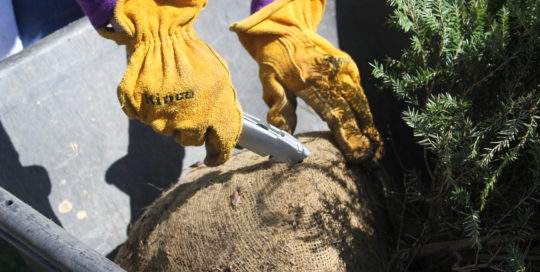
The process for planting containerized trees is slightly different. Dig a hole just slightly shallower than the root ball, maybe by one inch, and twice as wide as the container. This keeps the roots from settling too deep while still allowing them to penetrate the surrounding soil. Planting too deep is the leading cause of death in newly planted trees. If planting a B&B tree (roots wrapped in burlap), remove as much of the burlap as possible without breaking up the root ball. Remove all wires, twine, and cords. These have to potential to eventually strangle and kill the tree.
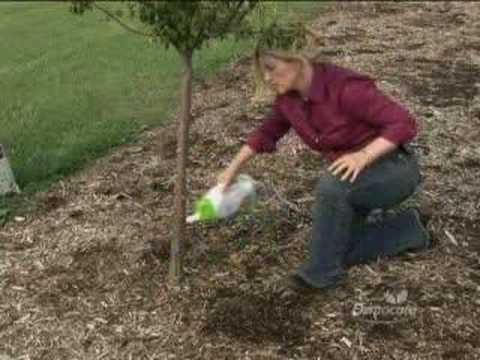
Make sure the bottom of the hole is moist. Use the soil that was dug from the hole to fill around the tree’s root ball. Mulch the tree to at least the drip line (where the tips of the leaves are), two to three inches deep, and keep it away from the trunk by at least 2 inches. Again, thoroughly water-in your new tree. I caution against fertilizing a tree during the first growing season with anything other than a slow-release plant food like Osmocote because too much nitrogen can burn the tender roots which will slow the growth and delay it becoming established.
How to Move a Small Tree to a New Location
Let’s say that you need to move a small tree due to construction or some other reason that places the tree’s life in jeopardy. First prepare a new hole as described above. Then, dig as large a root ball as you can lift from around the tree that is going to be moved. Try to get as many of the roots as you can. You are going to damage roots, so don’t panic! After you get the tree dug out, prune at least a third of the canopy off. The reason for this is, those roots that you cut are now unable to support the top of the tree, so by pruning the top you are equalizing the root-to-leaf ratio.
You Don’t Have to Wait
One last thin. You don’t have to wait until Arbor Day in your State to plant a tree. In many places throughout the country, fall is a good time for planting, especially in the south. There is a wise old tree-planter’s saying that goes something like this, ‘The best time to plant a tree was twenty years ago, the next best time is now!’
Related Featured Articles
Related Videos
Related Blogs
Here’s more information about gardening that you’re going to want

Watch a Gardening Video
Learn About Osmocote Products

Read a Gardening Blog