

Move Your Houseplants Outdoors
By Jean Starr
Houseplants are waking-up for springtime. If you look closely, even the plants left in the darkest corners of the house are looking fresher. New growth is pushing-out to remind you that the plant is ready to resume its journey in the cycle of life. Why not move your houseplants outdoors?
Note, of course, some plants don’t make it through the dark days of winter. That’s perfectly okay. That doesn’t mean you did anything wrong. When the plant is dead, it’s time to say goodbye.
Move your houseplants outdoors for the summer
If you plan to spend any time on the patio, let’s bring along some of your prettiest houseplants. There are several varieties that can make the transition to the porch or patio. But first, they need to be acclimated to a much higher light level. Even succulents need to cool their heels for several days in a shaded area before positioning them in the sunshine for the summer.
Houseplants that thrive in a bright corner of a room, especially, will love it outdoors. After all, it’s where their ancestors grew up — close to the ground beneath taller plants in the tropics.
Increased light brings out the best in Dracaena and Cordyline, turning leaves bright. Even Philodendrons appreciate the outdoors as their leaves increase in size and take on a perkier attitude.
Where to move your houseplants outdoors
A benefit of growing houseplants in containers (or keeping them in the same ones) is that you can move them around until you find a spot they like. Personally, I take care that mine receive no more than two hours of direct sun, and some receive no direct sun at all. After planting the summer-time container, I place those with houseplants on the north side of the house under deep eaves.
It’s okay to mix houseplants with other plants
Don’t be afraid to mix your houseplants with other tropicals, annuals and even perennials. But remember, it will be necessary next fall to pry them from their summer-time friends while leaving enough roots to once again survive on their own.
What to do next fall with outdoor houseplants
You may be tempted to bring the entire summer-time combination planter inside for winter. I thought so, too, but none of the plants fared well due to competition. Plants are more forgiving about the perfect environment while outdoors in summer. Bring them into a dark, dry environment, and they start bickering like children, each wanting the biggest share of very limited resources. When it comes time to prepare for winter, separate the plant you want to keep as a houseplant — carefully and with as many roots as you can still attached.
Six houseplants that can travel outside in summer and back indoors in winter
Here are six of the easiest plants that can make the transition to the outdoors in summer. They successfully lived for at least one winter inside and one summer outdoors:
- Aphelandra squarrosa The well-known zebra plant makes a great houseplant if you can give it enough light and humidity indoors. But grow it outdoors and it will produce flowers with bright yellow bracts that can last for several weeks. I grew this in a mixed planter, where it bloomed in late summer.
- Aglaonema (ag-lay-oh-NEE-muh), or Chinese evergreen, is quickly becoming more popular, the more common forms often appearing in grocery stores. Even the newer, more colorful varieties are easy to locate, and make very forgiving houseplants. Grow them outside in a mixed planter, and they’ll practically glow, the colors in their waxy leaves intensifying in bright light.
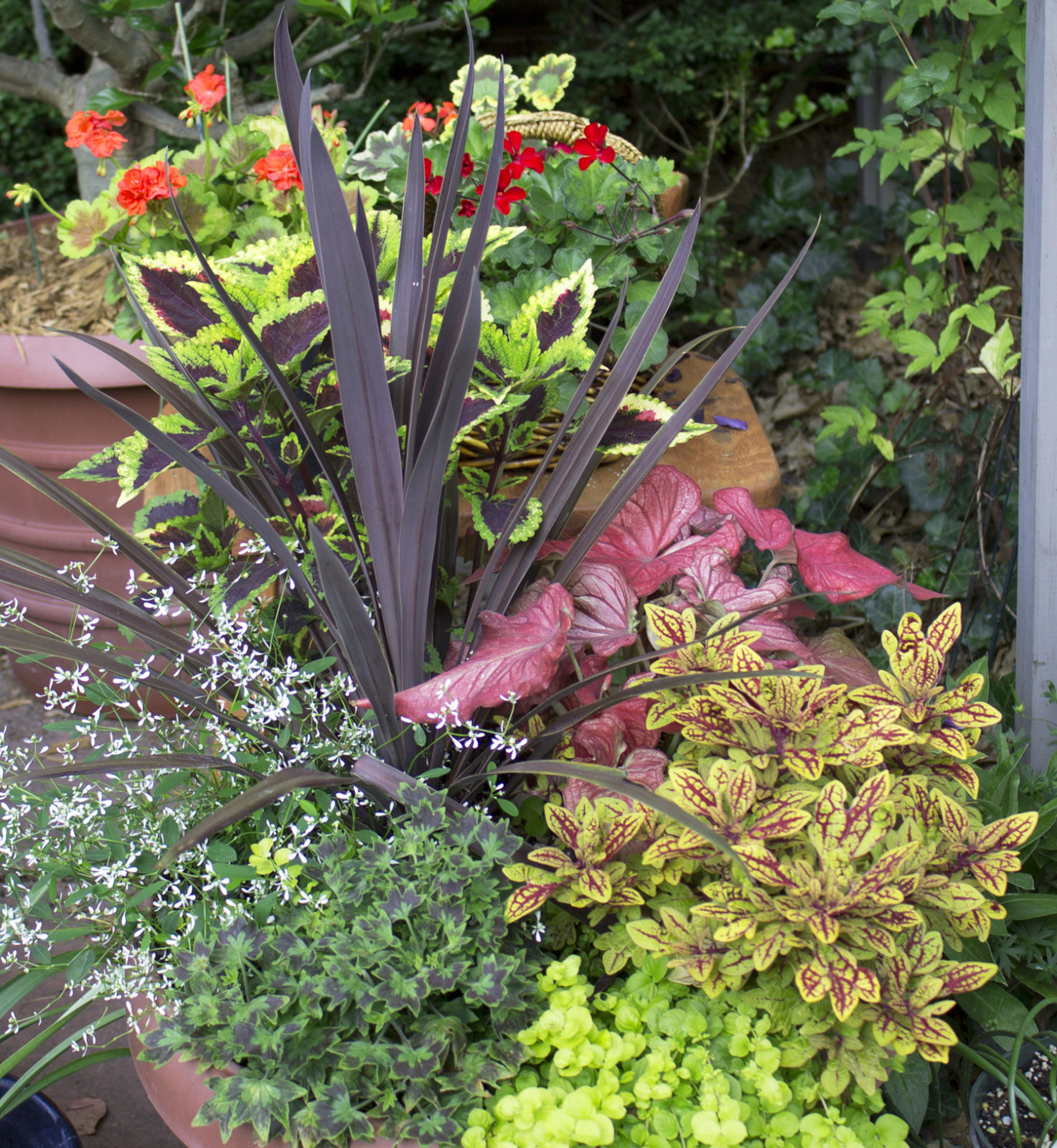
- Cordyline makes the perfect vertical accent in a mixed planter. I grew several last summer. They made it through the winter indoors in a brightly-lit spot. The shorter, broad-leaf types, also known as Ti plant (Cordyline terminalis) varieties like ‘Cherry Cordial’ and ‘Miss Andrea’ need more space and tend to spread out in a pot. In the same genus is Cordyline australis, a more upright, tree-like type that includes cultivars ‘Pink Champagne’ and ‘Red Sensation’. Either can serve as the perfect central “spike” in a combination planter. Below: Cordyline ‘Red Sensation’ adds tall, dark drama to this mixed container. Photo by Jean Starr
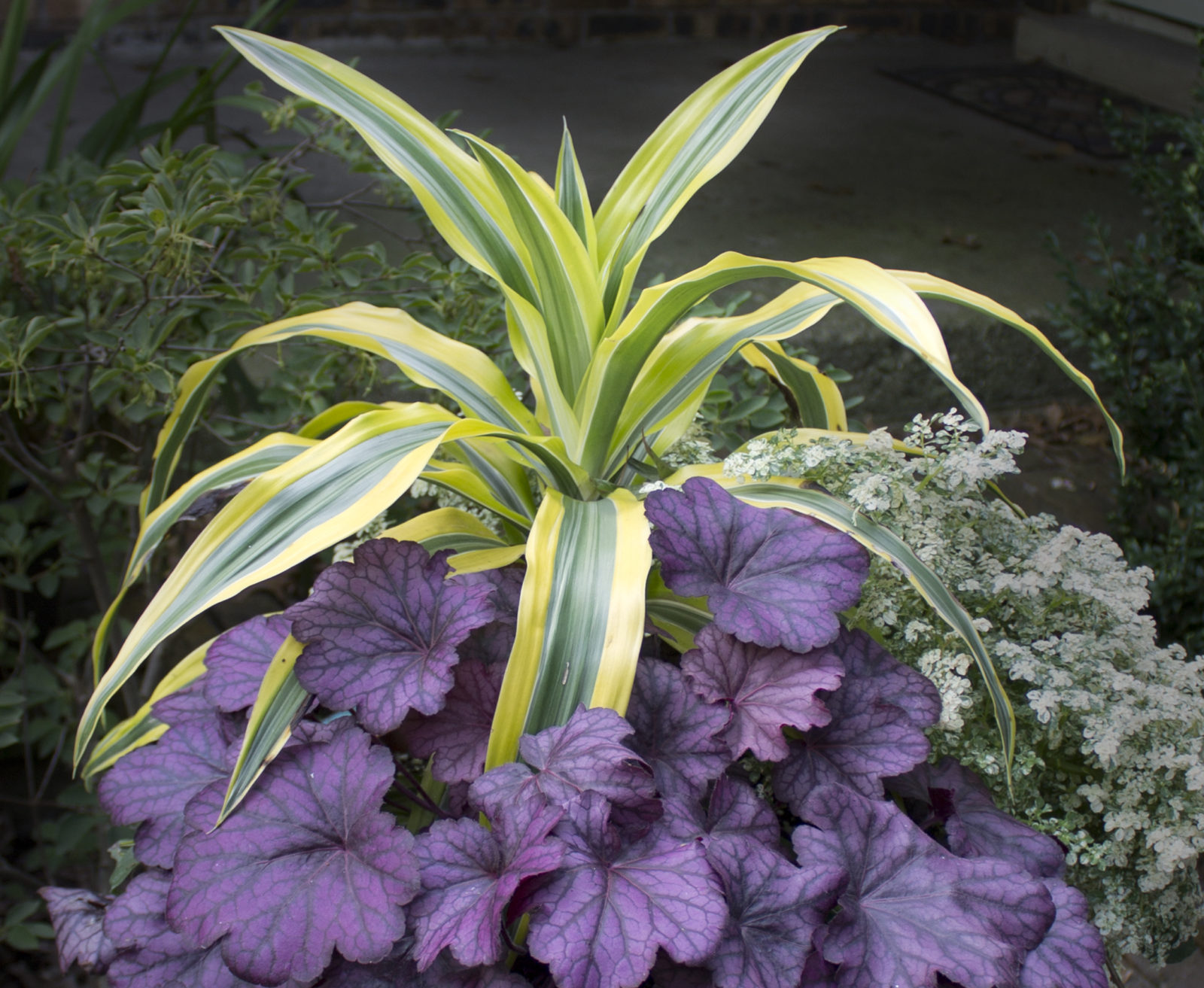
- Dracaena is one of the most common houseplants around. Back in the 70s, I had one commonly known as Madagascar dragon tree. It grew from a 12” stem to a six-foot tree. When I had to move, I lacked space for it so we parted ways. I didn’t know it at the time, but it was just one of several types of Dracaena. A couple of years ago, I purchased a new Dracaena plant, a beautiful variety called ‘Lemon Lime’. It was combined in an outdoors container with a deep-purple variety of coral bells. When I brought ‘Lemon Lime’ inside, it lost most of its bright gold color because it didn’t get as much sun. Still, it brightened up a corner until I shuttled it back outside for a second summer season. Below: Dracaena ‘Lemon Lime’ plays off the dark leaves of Heuchera Primo ‘Wild Rose’. Photo by Jean Starr
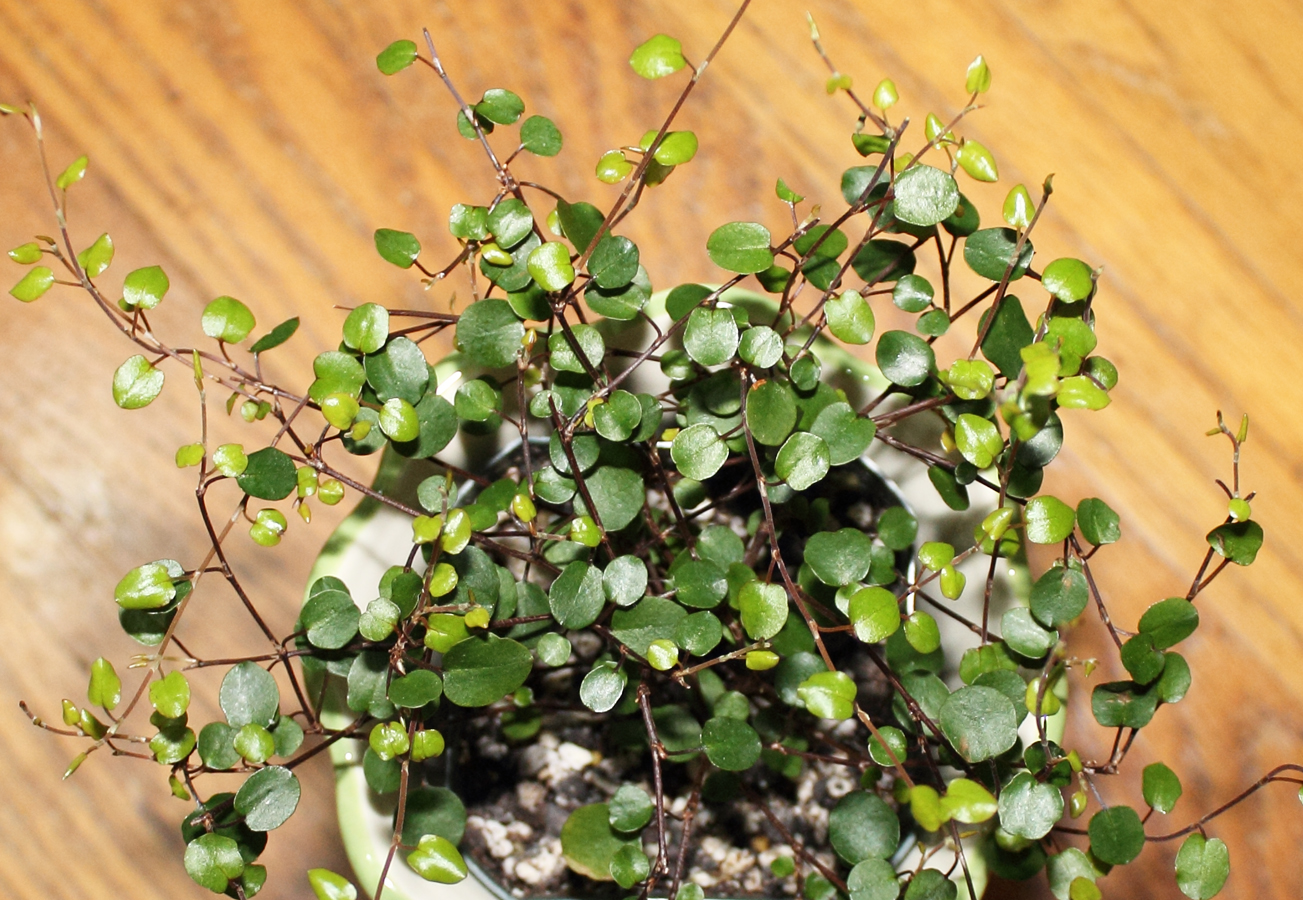
- Muehlenbeckia axillaris is a name with which to become more familiar. More commonly known as wire vine, this delicate trailer was made for a pot — either indoors or out. It’s perfect as a filler in a mixed container in sun or part shade. You can easily cut it back if it gets too long. Wire vine is grown for its round green leaves and reddish stems. It can easily be started from cuttings, and it doesn’t mind being away from direct sun for the winter. Below: Wire vine is one of the most versatile plants for both indoors and out. Photo by Jean Starr
- Philodendron varieties are as abundant as those in the Dracaena It is easy to grow indoors. For a glimpse of just a few Philodendrons, check Costa Farms’ list. The heartleaf ivy type, sometimes confused with Pothos, is often the first houseplant people try to grow. It will stretch across a room toward a window when it doesn’t get enough light indoors. For outdoors, there are more better candidates such as the hybrid Philodendron‘Jungle Boogie’. It’s a large plant that spreads thick stems outward when grown indoors. I prefer to summer it on my north-facing front porch where it grows straight and upright with a number of new leaves.
There are other houseplants that can make it as patio plants in the warmer months, but these six are my favorites.
When to move houseplants outdoors
One of the best aspects of using houseplants outdoors is that you can purchase them in spring and enjoy them indoors until it warms up enough to shift them into your summer containers. A good time to introduce houseplants into outdoor play-time (Zones 5 – 6) is mid-May, when nights are warmer. Put them outdoors by themselves, or mix them with other plants. You’ll be amazed how they grow when they visit your personal tropical paradise.
Related Featured Articles
Related Videos
Related Blogs
Here’s more information about gardening that you’re going to want

Watch a Gardening Video

Learn About Osmocote Products

Read a Gardening Blog

Find a Gardening Podcast
Membership has its perks!
Become a PlantersPlace member! Registered users can ask Marianne Binetti questions, create personal photo gallery and post product reviews.