

Blue is the rarest color in the plant world. Plants often referred to as blue are likely to be purple, violet, or lavender. So when you find a true blue (or close) plant or flower, it’s a good idea to add it to your garden. This article offers tips on where to place blue plants so they stand out.
Personally, I can never have enough blue in my garden. More than green, or even white, blue and all its versions — from near-turquoise to deep purple — has the power to soothe, cool, and play well with other colors. Blue takes on background duties as bright reds and yellows clamor for our eyes’ attention. But, in the right light and circumstances, blue can even be the main attraction.
The first blues in the garden
In early spring, blue is noticeably cheerful. It’s one of the only colors out there besides the browns of last year’s leaves. Even brightly-colored daffodils can’t steal the show from the likes of Anemone blanda, hyacinth, and Muscari.
After the bulbs come some of my favorite shade lovers, including Brunnera ‘Hadspen Cream’ or ‘King’s Ransom’, both with leaves generously blotched golden-cream, and pretty enough to hold its own without flowers. But then the blue flowers bloom on tall, wiry stems, creating a show that can’t be ignored. Brunnera prefer cool shade. You can cut them back when the leaves begin to look tattered.
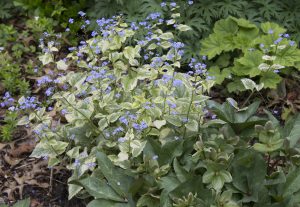
Brunnera King’s Ransom – photo by Jean Starr
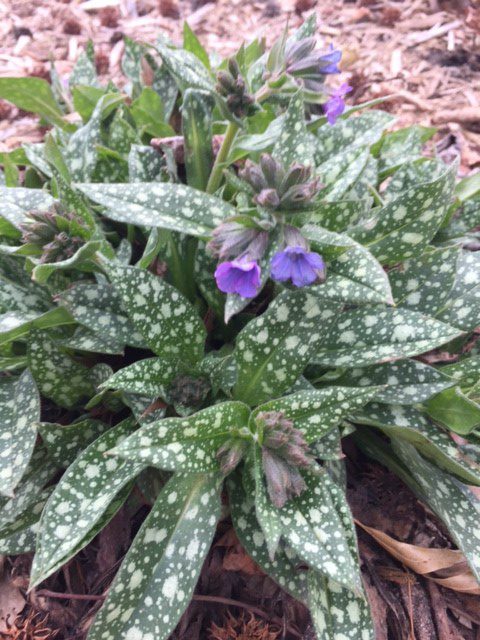
Commonly known as lungwort, Pulmonaria is one of the easiest plants to grow in shade or partial sun. They’re so happy in my garden. They self-sow, giving me more than plenty to share or spread through difficult areas of the garden. Flowers emerge pink and mature to blue. You’ll have plants with both colors right above the 10 – 12” plants’ green and silver mottled leaves.
Around the same time, a little cutie with a strange name sports the same color combo with blue flowers edged in creamy white. Navelwort (Omphalodes) ‘Starry Eyes’ blooms before the summer gets started, assuring this six-inch tall beauty gets the attention it’s due.
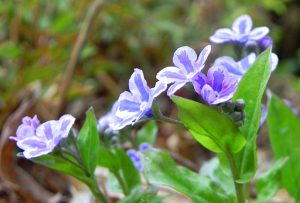
Omphalodes – photo by Jean Starr
Late spring blues
Blooming in the sun around the same time are Siberian iris and Centaurea, or perennial bachelor’s buttons. While these are not the only plants with blue flowers that bloom around early May, they are among the easiest. Unlike the bearded iris we are mostly familiar with, the Siberian types (Iris siberica) only need to be divided every three or four years. After blooming, their supple upright leaves remain fresh throughout the season. Siberian iris come in colors that range from white to pale yellow, pink, blue, and purple.
One of the bluest flowers appears on perennial bachelor’s buttons, or Centaurea. It is available in colors that range from purple to blue, and most recently, white. Centaurea ‘Amethyst in Snow’ a white flowered variety, sports a deep purple center, just like its blue counterpart, Centaurea‘Amethyst Dream’. I like to plant the two together, the plants’ centers creating a color echo, in which each variety shares a specific hue.
Looking right at home at a woodland’s edge Camassia blooms in varying shades of blue. This hardy American native will tolerate damp meadows, but does equally well in a drier spot. It blooms best in partial shade, but will flower in full sun as well. One of the deepest blue varieties, ‘Blue Danube’, looks great with a golden-leaved hosta in the background, the Camassia’s deep yellow stamens echoing the yellow hosta.
The University of Illinois Extension defines a color echo as repeating a similar color in different plants can be used to good effect.
Summertime blues
When the summer heats up, there are even more blue plants to choose from. Just a few annual flowers that come with blue flowers include Angelonia, Calibrachoa, Petunia, Salvia, and Verbena. Don’t forget the silvery foliage plants like the annuals Artemisia, curry plant, Dichondra ‘Silver Falls’, Dusty Miller, and Eucalyptus, all of which impart a cooling touch to blue flowers.
One of my favorite blues for summer is Salvia, especially the annual varieties. And if you’re looking for visits from hummingbirds, don’t think they only go for red flowers. Salvia ‘Amistad’, a deep purple shade, constantly hosts a hummer or two in search of nectar.
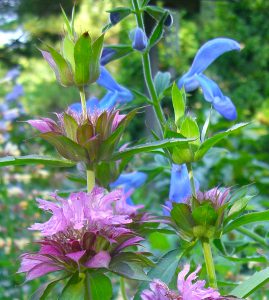
Salvia and Monardo – photo by Jean Starr
If you can find it, try dwarf morning glory (like Evolvulus ‘Blue My Mind’), which is much better mannered than morning glory. This true blue annual stands up to the hottest of temperatures without faltering if it’s kept watered.
Another unusual source of blue is passion flower. If you have long, hot summers and a spot with a full day’s sun, plant this vine and stand back. Depending on the variety, it will grow into a vigorous space hog or send out graceful, flower-covered vines. I’ve had pretty good luck with tropical passion vines from Grassy Knoll Exotic Plants in Portland, OR.
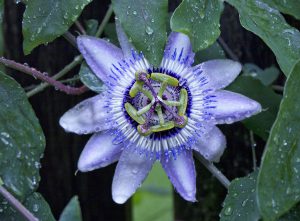
Passiflora Lambiekins (Passion Flower) – photo by Jean Starr
Falling for Blue
Hardy plumbago (Ceratostigma plumbaginoides) offers two seasons of interest for the price of one. This shade or sun groundcover sports true blue flowers in late summer just before its leaves turn red for fall.
Fall tends to enter the garden scene in the form of mums—typically in shades of gold. Finally, garden centers are offering asters as a blueish counterpoint. While it’s best to add hardy asters to the garden in spring, it’s hard to resist those pots of blue cushions right next to the mums.
Starting its bloom in late summer, bluebeard (Caryopteris) carries on through fall if the weather is on the dry and sunny side. This plant is considered a subshrub, meaning that in cooler climates it should be cut back in late spring so that it will be bushier and have more blooms. Sometimes referred to as “blue mist spirea,” there is no relation between the two.
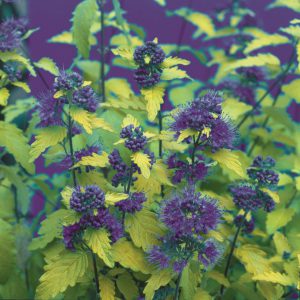
Caryopteris ‘Sunshine Blue’ – photo by Proven Winners
Don’t forget the berries, which typically arrive in late summer-early fall. Viburnumdentatum, also known as arrowwood viburnum provides low-maintenance color in the form of glossy blue berries. A compact hybrid, Viburnum ‘All That Glitters’ is more compact than the species, and produce fruit if its pollinator, ‘All That Glows’, is planted nearby.
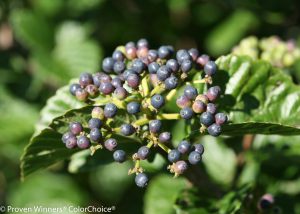
Viburnum ‘All That Glitters’ – photo by Proven Winners
Blue deliberations
Although blue tends to fade into the background if placed next to hot colors like yellow, the opposite is true if blue is the color of a reflective surface. I placed a blue gazing globe at the end of a path between golden-hued plants, and it was the first thing my eye landed on.
I like to use blue as an accent in the garden, simply because there is never enough of true blue in a garden, so it attracts attention. In the case of the blue gazing globe, the pale blue reflects more light than the darker colors around it. An accent of true blue provides a fixed eye-catcher in the midst of plants whose flowers and leaves change throughout the season.
When plant-shopping this spring, look for plants that have blue flowers, or bluish or silvery leaves. There are more than you would think. And don’t forget the blue you don’t have to work for—the sky on a beautiful day.
Related Featured Articles
Related Videos
Related Blogs
Here’s more information about gardening that you’re going to want

Watch a Gardening Video
Learn About Osmocote Products
Read a Gardening Blog